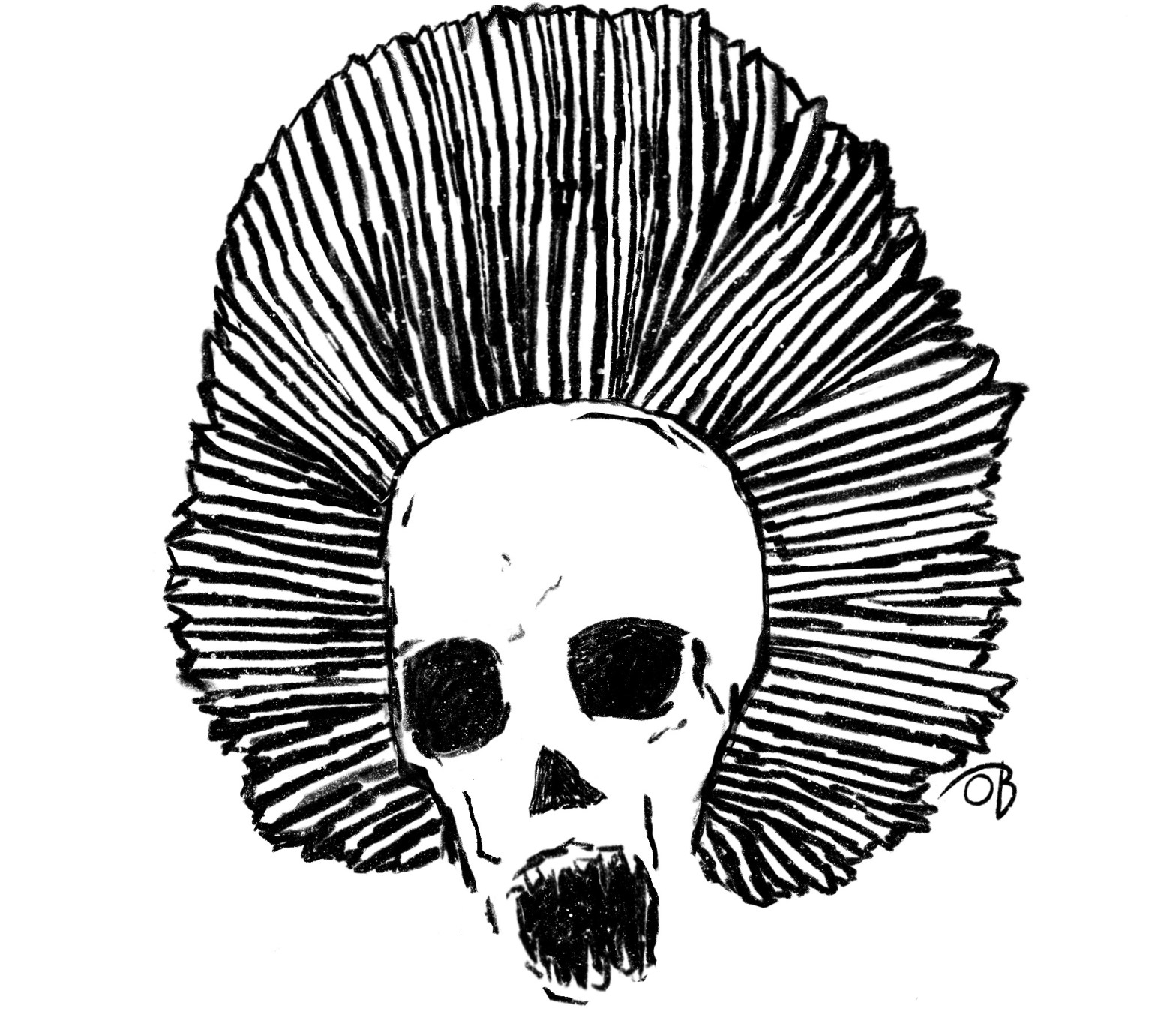
Frankenstein
(Guillermo del Toro, 2025)
One senses del Toro’s readings. Victor Frankenstein would prefer to remain in the Imaginary rather than the Symbolic order, a state of unified egocentrism over fragmenting social entanglement. This is perhaps true of all transgressive figures in the Promethean/Faust lineage who defy the codes and strictures of their societies, but del Toro goes so far as to make a visual gag of it: we never see his Victor (Oscar Isaac) drinking anything other than elegant little glasses of milk, a riff on the maternal unity he strives to reconstitute via mastery over dead flesh. His sin against his own creation, in a major departure from Shelley’s 1818 original, is not disgust at the abject ugliness of the creature (Jacob Elordi) but the tyrannical imposition of his own law and order, his frustration that the creature appears unable to speak anything other than his creator’s name. (This can’t but reflect upon “le nom/non du père” as initiating entry into the Symbolic and confrontation with the reality principle.) For del Toro, Frankenstein’s abhorrence lies in the fact that he takes his milk only to deny it to others.
Any additions made to a text that undergoes adaptation are telling. del Toro adds this detail concerning the Frankenstein family: it has a fortune that has diminished considerably due to a series of revolts on his mother’s inherited plantations. Thus, in order to undertake his experiment — which in this iteration, advanced in time to the mid-nineteenth century, is on the grand scale of mechanized industry and takes place in a Gothic folly on the grand scale of William Beckford’s Fonthill Abbey — Frankenstein needs external funding. Essentially, he’s in search of a good research grant, but banished to the fringes of academic respectability following a botched Elephant Man-style presentation of his early findings, he must rely on a private benefactor. Atlantic slavery and the rise of capitalism are lingering in the background here, more as a ghostly recognition on del Toro’s part than a developed thematics. But the details stand out. As does the director’s compositional style, as much about set design and art direction as cinematography. del Toro, known for his storyboarding, elaborate character biographies, and an aesthetic sensibility that lands somewhere between William Blake and William Morris (with a pulpy dose of EC horror comics thrown in) is operating on pure delight. The film owes its most cinematic horrors to the maturity of that style — in particular, a recurring dream in which Victor is visited by a fiery angel of life and death. The form and figure of the angel may remind us of similar spectacles in Crimson Peak (2015), Pan’s Labyrinth (2006), and even The Devil’s Backbone (2001) — it may also remind us of the apocalyptic visions of M. G. Lewis’s The Monk (1796) — but never has del Toro exhibited such gruesome force as when Victor’s angel removes its mask.
More evidence of del Toro’s readings: he has essentially re-mixed Shelley’s original with elements from a wide range of subsequent stagings and adaptations, from the character shuffle of Richard Brinsley Peake’s Presumption (1823) to the shackles-and-lightning spectacles of James Whale (including a jolt of Whale’s humour) and even an affectionate nod to Kenneth Branagh (Frankenstein naked, muscular, and wet for his crucial discovery of how to impart the “spark” of life). The most compelling inference, in del Toro’s reading of Shelley, is the actualization of what was always an implied possibility in her novel: that, constituted of scientifically/alchemically-resurrected flesh, the creature may be unable to die. Much has been made of the creature’s resolution — promised but never confirmed — to die by throwing himself onto a pyre at the northernmost extremity of the globe at the close of Shelley’s original. How exquisitely painful to imagine that — if we take him at his word — the creature might have attempted this only to discover its impossibility. The persistence of life is terribly sublime. del Toro thus leans into the undead topos of the Romantic age, bringing the creature into closer contact with the pop-existentialist vampires of Anne Rice, whose roots always lay in Byron’s “Fragment of a Novel” (1819) and John William Polidori’s elaboration thereof, The Vampyre (1819). Indeed, Jacob Elordi as the creature, when finally revealed and cast out into his Rousseauvian infancy in the woods, is reminiscent of no one more than Tom Cruise as the vampire Lestat, swamp-bedraggled and cadaverous after his attempted murder by blood-poisoning/exsanguination at the hands of the child-vampire Claudia (Kirsten Dunst) in Neil Jordan’s Interview with the Vampire (1996). Shelley probably would have smiled on all this. Recall Victor’s words:
I considered the being whom I had cast among mankind, and endowed with the will and power to effect purposes of horror, such as the deed which he had now done, nearly in the light of my own vampire, my own spirit let loose from the grave, and forced to destroy all that was dear to me.1
The only really objectionable thing about this film is that the creature isn’t objectionable enough. He kills only in self defence or inadvertently, when tossing aside Victor’s brother, William (played by Felix Kammerer and allowed to reach adulthood in this version), on the night of the latter’s wedding to Elizabeth (Mia Goth). William’s death shortly thereafter from head trauma is hardly commensurate with the malevolent violence of strangling his little boy counterpart in Shelley’s novel, to say nothing of framing the doomed Justine and murdering Clerval and Elizabeth in cold blood. As is his wont — see The Shape of Water (2017) — del Toro loves his monster a little too much, at the expense of the ambiguities that structure Shelley’s novel and are responsible for its many critical and cultural afterlives. We aren’t left with any doubts by the time del Toro tacks on a sentimentalized Byron quotation as the credits roll. But this is besides the point. The real point is the compositional triumph of the creature’s bulk, seen from afar against the dim horizon of the polar desert, his indistinguishable features wrapped in furs, lost in darkness and distance — or maybe another glass of milk.
- Mary Shelley, Frankenstein; or, The Modern Prometheus, ed. Susan J. Wolfson (New York: Pearson Longman, 2007), 54. ↩︎
 OLIVER BEDARD