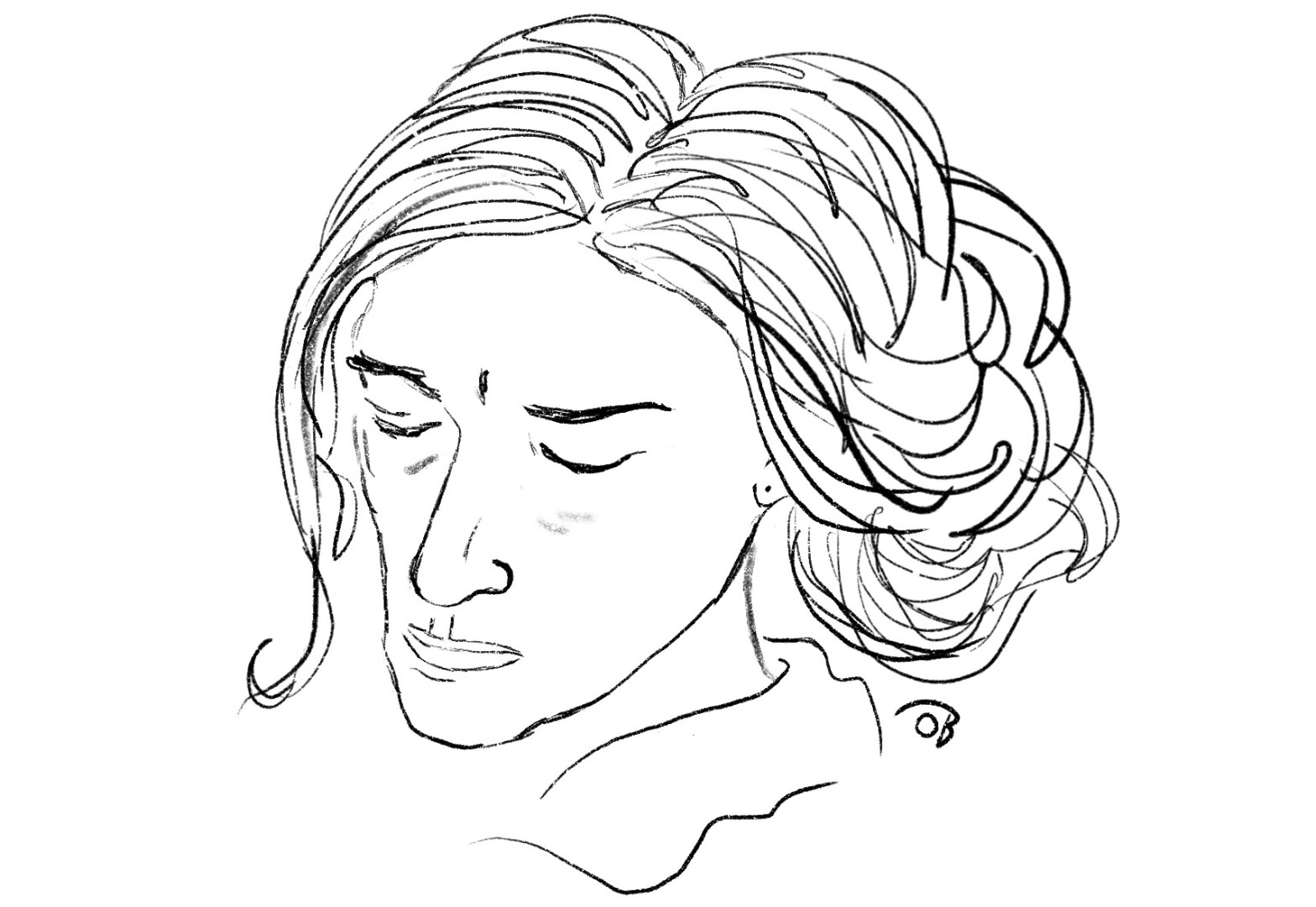
Mildred Pierce
(Todd Haynes, 2011)
It all comes down to her squint. In James Cain’s 1941 novel, he describes it this way:
Into her eyes, if she were provoked, or made fun of, or puzzled, there came a squint that was anything but alluring, that betrayed a rather appalling literal-mindedness, or matter-of-factness, or whatever it might be called, but that hinted, nevertheless, at something more than complete vacuity inside. It was the squint, Bert confessed afterwards, that first caught his fancy, and convinced him there was ‘something to her.’1
Two screen actors have attempted to embody this squint in the more than eighty years since the novel’s publication: Joan Crawford, who won an Oscar for her performance in Michael Curtiz’s 1945 film noir treatment, and Kate Winslet, whose performance in Todd Haynes’s five-part miniseries, in 2011, surpasses any she has given before or since. (Watching Winslet play the great grass widow of American literature, I had the sense that her entire career, from Heavenly Creatures [1994] to the latest James Cameron, is ancillary to the squinting, driven contradiction of Mildred Pierce.)
It’s all about the eyes with Mildred, though not necessarily about clear sightedness. After all, what lies most immediately in her line of sight is furthest from recognition: not the industrious growth of her entrepreneurship from the ruin of Depression-era penury but the monomaniacal fixation with her sang-froid narcissist first-born daughter, Veda. Cain records it best, with a plainness of detail notable for its deviation from the noir-stylized first-person prose of The Postman Always Rings Twice (1934) and Double Indemnity (1936), when Mildred uses a pair of opera glasses to take a closer look at a Veda-turned-coloratura-soprano during the latter’s triumphant concert at the Hollywood Bowl:
Up close, she could see the wan, stagey look that Veda turned on the audience, and the sharp, cold look that she constantly shot at Mr. Treviso, particularly when there was a break, and she was waiting to come in. It shattered illusion for Mildred. She preferred to remain at a distance, to enjoy this child as she seemed, rather than as she was.2
“She preferred to remain at a distance.” No need for glasses — I prefer to squint. For all the emphasis on musicality and musicianship in both the novel and its author’s life — recall that Cain’s career in letters was a fallback position for a failed career as a singer — Mildred Pierce is governed by visuality. But it’s a broken, distanced visuality bent upon untenable desires and dreams. The irony of Mildred’s surname (Pierce as in “a piercing gaze”) is that no matter how hard she squints, she will not see. The novel, Cain’s first major foray into straight literary realism, is structured by a dysfunctional, deficit-laden economy of dreams. Todd Haynes luxuriates in that realism even as, perhaps inevitably after his supreme accomplishment in Douglas Sirk-pastiche, Far from Heaven (2005), he revivifies the latent melodramatic energies of Cain’s novel. But where Curtiz was intent — due to studio pressure — on transforming Mildred Pierce into a more feminocentric version of Double Indemnity or Postman, Haynes drops Warner Bros.’ tacked-on murder plot and beckons us instead to fixate on all the details Mildred only selectively observes, right down to server tip disputes, restaurant order slips, itemized bills, and each button, fold, and zipper of the work uniforms adorning and uncovering the bodies that populate Mildred’s Great-Depression milieu. Likewise, he luxuriates in Cain’s dialogue with a degree of faithfulness that is just shy of neurotic.
There are limits to such fidelity. Surprisingly, given his roots as an NQC darling, Haynes offers only a glimpse of the incestuous dimension of Mildred’s affection for Veda (Evan Rachel Wood), coupled with a jealousy that attaches not to her second husband, the loafing-yet-penniless playboy Monty Beragon (Guy Pearce), when she discovers near the novel’s close that he is sleeping with Veda, but to the daughter herself. Such an overbearing cathexis is a hard thing indeed to depict, for what are we to make of a bereaved mother who “inhales” the scent of her pre-pubescent daughter on the night her younger sister dies, and finds “a little more than peace”?3
There was something unnatural, a little unhealthy, about the way she inhaled Veda’s smell as she dedicated the rest of her life to this child who had been spared, as she resolved that the restaurant must open today, as advertised, and that it must not fail.4
And what to make of Veda, who, though not a murderer, exhibits a sociopathic streak to rival that of Phyllis Nerdlinger in Double Indemnity, the deadliest of noir’s femmes fatales? Veda’s scheming brutality is all the more striking because it’s directed not at some concupiscent insurance salesman, but the woman who granted her life and nurtured her ambition. It’s as though the core of the relationship between mother and daughter is displaced between genres, and what survives the transition to social realism is a psycho-sexual schism connecting Cain’s noir to its Gothic predecessors: Poe (of “The Fall of the House of Usher”), Melville (of Pierre; or, The Ambiguities), Lewis (of The Monk), and Coleridge (of Christabel). Such generic displacements are of course part and parcel of the history of realism and naturalism in fiction, especially that of nineteenth-century Britain and France. Dickens, Eliot, Hardy, and Zola are full of such incongruous Gothic pockets, and in the later rise of noir, debts and references double back upon themselves (Zola’s breakthrough novel, Thérèse Raquin (1867), is widely-noted as a source for the plot of Cain’s Postman, a novel equally indebted to the murder trial of Ruth Snyder, which Cain personally reported on during his career as a journalist).
We all love Mildred Pierce because she is driven and willful and confounding; because she embodies both rugged individualism and its unviability; because she is so perverse and only willing to see so much; and because, like her, we find ourselves surrounded by history-as-material-process on all sides. We will never know quite what to make of Mildred, and that is why she is probably Cain’s — and Haynes’s — finest accomplishment. Desire is an irreducible problem, and it provokes a squint.
 OLIVER BEDARD